
A Preface of Sorts
Mark and I have talked most weekday mornings for nearly a year—since January 2025–when life doesn’t interrupt our schedules. Enclosed are a few reflections I’ve written over the past eleven months. Here’s what continues to unfold:
“I’ve learned that faith doesn’t always make sense when you can’t find your glasses. I’ve searched the kitchen, retraced my steps, even looked in the car—only to discover they were already on my head. That moment always makes me laugh, but it also reminds me that what we search for is often already with us. We just haven’t believed it yet.” —RLR
A Trust That Delights in Being Small
From the Reflections of: Comprehending the Incomprehensible by Ron Randle
Look where the best of my thinking has landed me
There is a kind of trust that delights in being small before Infinite beauty. I didn’t always understand that. For most of my life, I thought spiritual maturity meant growing by carrying more, knowing more, managing more. But I’ve come to see that real becoming often feels like shrinking in the best possible way.
Part of becoming is seeing and accepting my smallness. It’s not a pejorative thing. It’s a release. It’s a quiet surrender to the One I’m dependent on. Getting to that place, though, isn’t easy. The process of seeing myself as small has always been arduous while it’s happening. It feels like a loss at first.
But in time, it becomes clear that what’s being removed is the illusion of control. And, the burden begins to lift the moment I surrender.
To paraphrase Mark, my virtual walking buddy, “Look where the best of my thinking has landed me— in misery.” He’s right. My best thinking has often built walls instead of windows. The real freedom began when I stopped trying to be the one holding everything together and let myself be held.
Smallness before Infinite beauty isn’t humiliation, it’s healing. It’s the place where I stop striving to be significant and start resting in being known. The burden of proving gives way to the joy of belonging. What once felt like being reduced turns out to be the restoration of perspective: God is big enough, and that’s finally enough for me. And, it is a delight to know you are being held by your Father.
—Postscript—
“My heart is not proud, Lord, my eyes are not haughty; I do not concern myself with great matters or things too wonderful for me. But I have calmed and quieted myself, I am like a weaned child with its mother; like a weaned child I am content.”
—Psalm 131:1–2 (NIV)
Living a Life of Expectancy
(written from Maplewood, NJ in November)
By Ron Randle
I believe living expectantly grows as we live in awareness of God’s nearness.
My friend Mark often reminds me to stay curious—to look for what God might be showing me in each moment—particularly when traveling. That thought hovered in my mind when Liessa and I spent a weekend in Chicago this October, with her college friends—a close-knit clan of believers who have walked together for decades.
We got a call 10 days prior that they were getting together, and Liessa spontaneously said, “We will be there.” I was interested in going, though part of me wondered how I would fit in. Yet that weekend became like the autumn leaves that so captivated me here in Maplewood. Both moments invited me to pause and reflect on the beauty of God’s creation—one through the turning colors of nature, the other through the warmth of friendship and faith amid urban life.
In meeting her friends, I saw something more than nostalgia. I caught a glimpse of the joy Liessa had as a new believer for 3 years before graduating from the University of Iowa. It deepened my gratitude and thankfulness for the way God weaves our pilgrimages together. And, how His nearness reveals itself through people just as clearly as through creation. What made this time even more special is how they became family to Liessa and a bulwark to a conservative Jew’s recent acceptance of Jesus as Messiah.
Yesterday, when I drove Yael to soccer practice before her game, that same awareness surfaced again. It’s late Fall here in Maplewood, and the last traces of change have brushed the trees with color. Having lived and retired in California for the past twenty-seven years, I haven’t been surrounded by this kind of seasonal beauty in more than thirteen. So transfixed, I pulled over to take a few photos. Each frame was a reminder of how creation quietly invites our attention.
Maplewood is both urban and gently rustic, a place where contrast somehow works. But in that moment, it wasn’t the contrast I noticed—it was the nearness of God woven through it all. The wind, the colors, the stillness, the awe. It all spoke of Him.
“Forever since the world was created, people have seen the earth and sky. Through everything God made, they can clearly see his invisible qualities, his eternal power and divine nature.”¹
That verse came to mind. It reminded me that living expectantly can be seen not just in nature, but in the quiet rhythms of daily life—in the laughter of a child, in the kindness of a stranger, in the grace to begin again.
Expectancy awakens when we see the divine fingerprints present in what we often call ordinary.
Mark’s reminder about curiosity keeps circling back. To live expectantly is to be curious about what God is doing right now. There are treasures all around us. God’s invitations to see His handiwork, to notice His nearness, to delight in what He gives freely, always await us. These treasures are not our possessions. These are glimpses of grace meant to nourish our souls with joy.
“But we have this treasure in jars of clay to show that this all-surpassing power is from God and not from us.”²
Living expectantly isn’t just waiting for something to happen. It’s recognizing that something
God-breathed is already happening. It’s the awareness that God is near, moving in both the ordinary and the unnoticed. Expectancy is born from the awareness of God’s nearness. When I see through the lens of His nearness, everything—every leaf, every moment, every friendship—becomes a reminder of God’s moment treasures he richly provides.
¹ Romans 1:20 (NLT).
² 2 Corinthians 4:7 (NIV).
Walking in Union
Three Reflections on Friendship With God
“Us Two Got Them Two”
(inspired by Mark Davidson)
Part 1
A Reflection on Exodus 33:7–11
“Now Moses used to take a tent and pitch it outside the camp some distance away, calling it the tent of meeting. Anyone inquiring of the Lord would go to the tent of meeting outside the camp. And whenever Moses went out to the tent, all the people rose and stood at the entrances to their tents, watching Moses until he entered the tent. As Moses went into the tent, the pillar of cloud would come down and stay at the entrance, while the Lord spoke with Moses. Whenever the people saw the pillar of cloud standing at the entrance to the tent, they all stood and worshiped, each at the entrance to their tent. The Lord would speak to Moses face to face, as one speaks to a friend.”
Ten years ago Mark and I coached high school football together. He coached the offensive line. I did everything else that needed to be done because I had never coached football before and was simply willing to serve wherever I was needed. Every Monday afternoon practice he began to shape the offensive line strategy for the upcoming game. When the planning was complete, he always repeated the same mantra. “Us two got them two.” It meant the offensive linemen on either side of the center would work together to block the defenders in front of them, protecting the play and creating a path for success. It was simple. It was clear. It worked because it was done together.
One of Mark’s deepest desires is to be a friend of God. That desire might sound bold or lofty, yet Scripture gives us this picture in Exodus. Moses enters the tent of meeting. The cloud descends. God speaks to him as one speaks to a friend. It is not a small moment. It is not an unreachable moment. It is God drawing near to a human being in a way that is personal and real. The Infinite meets with the finite which He created.
“This is union.” These words do not stretch the passage. They express what Exodus reveals with quiet clarity. God initiates friendship. God draws near. God speaks in a way that invites relationship, not distance. When our spiritual eyes begin to open, we see that God is always more relational than we imagined. His nearness is not confined to tents or clouds or holy spaces. It appears in the rhythms of our lives and in the moments we hardly notice. It even shows up in a simple phrase like “Us two got them two.” Something practical.
Something ordinary. Something used to motivate high school linemen. Yet inside that phrase is a reminder that we never stand alone. God works with us. God stands beside us. God desires to enter and reveal Himself in the ordinaryness of our lives as a friend.
Selah. Transition:
Union does not always begin in tents or clouds. Sometimes it begins in marriages, friendships, and the familiar patterns that shape our days. If Exodus shows us that God joins Himself to us, the next reflection shows how we learn to join ourselves to one another.
“Us Two Got Them Two” Series
(inspired by Mark Davidson)
Part 2
How Two Very Different Communicators Became a Great Team
By Ron Randle
I have come to understand how Liessa and I communicate and why it works. She speaks in soundbites. I speak in hyperbole. She gives you the headline. I give you the entire front page, the editorials, entertainment, and travel sections. Somehow, this pairing has worked for decades.
Liessa delivers clarity in short form. She trims the fat. She gets to the point with a precision that does not complicate what is already simple. Her sentences arrive ready to use. They are sturdy. They are efficient. They land with accuracy. In ten words, she can summarize what it takes me three paragraphs to explain.
My communication is different. I do not speak in soundbites. I speak in sweeping arcs. If Liessa gives you the snapshot, I hand you the full photo album. If she offers the essence, I offer the world it came from. My stories grow. My sentences stretch. There is always a little comedy in that, and we both know it.
So how do the two of us work so well together when our styles are so different? The answer is simple. We meet in the middle. Her brevity protects my clarity. My depth supports her insight. She trims what does not matter. I reveal what needs more space. Together, we create one communication that serves both of us.
When she talks, I have learned to listen for the center of the moment. When I talk, she listens for the meaning that is trying to take shape. Her soundbites sharpen my thinking. My hyperbole softens her precision. Our strengths bend toward one another until they create one communication that lives in balance.
We became a team not because we communicate the same way but because we trust the way the other communicates. She speaks from wisdom. I speak from wonder. She gives me the anchor. I give her the horizon. Together we make one story that keeps finding its way toward truth.
Selah. Transition:
Union with one another becomes preparation for something deeper. These everyday partnerships teach us that friendship, trust, and shared movement are not only relational skills. They are spiritual training for walking in union with God Himself.
“Us Two Got Them Two” Series
(inspired by Mark Davidson)
Part 3
Walking in Step: The Quiet Yoke of Friendship With God
Ron Randle
There are seasons when the road ahead feels more concealed than revealed. We sense movement but cannot name its direction. We feel a pull, yet the destination remains hidden. Sometimes those moments take the shape of aging, protracted illness, unexpected tragedy, or grief. They remind us that clarity is a gift, not a guarantee. And in the quiet uncertainty of those seasons, we discover that God does some of His most personal work.
The unknown has its own kind of nearness. It is the place where trust has to breathe. It is where we learn that faith does not begin with understanding but with companionship.
Friendship with God is not built on control. It is built on union, the quiet joining of our small steps with His gentle direction. We walk because He walks with us.
This truth has revealed itself across my life. I saw it in the way Liessa and I learned to communicate. Her clarity and my wonder meet and create union. I saw it in Mark’s linemen learning to move as one. All these small glimpses prepared me to see what Exodus reveals. God walks with His people in friendship and union.
It is extraordinary when we begin to recognize God’s design in both the ordinary and the unexpected places of our lives. It becomes a continuous revelation of what life in union looks like. It teaches us to walk in unity with a like-mindedness shaped by God. The more we are attentive, the more we notice that the various walks of our lives are best lived and best experienced in union.
Friendship with God is not about matching His pace. It is about receiving His pace. It is about letting Him set the rhythm and learning to walk in nearness with the One who leads. We let Him guide our stride. We let Him shape our direction. We let Him carry what we cannot.
This is the quiet yoke. It begins in marriages where two different communicators learn to move together. It forms on practice fields where linemen bend toward a shared assignment. It reaches its fullness in the tent of meeting, where God calls a human being His friend. And it continues in our own lives every time we step into the unknown and choose to walk with the One who walks beside us.
From Ron’s Journal — December 3, 2025
What Mark Saw on the Dawn of a New Day
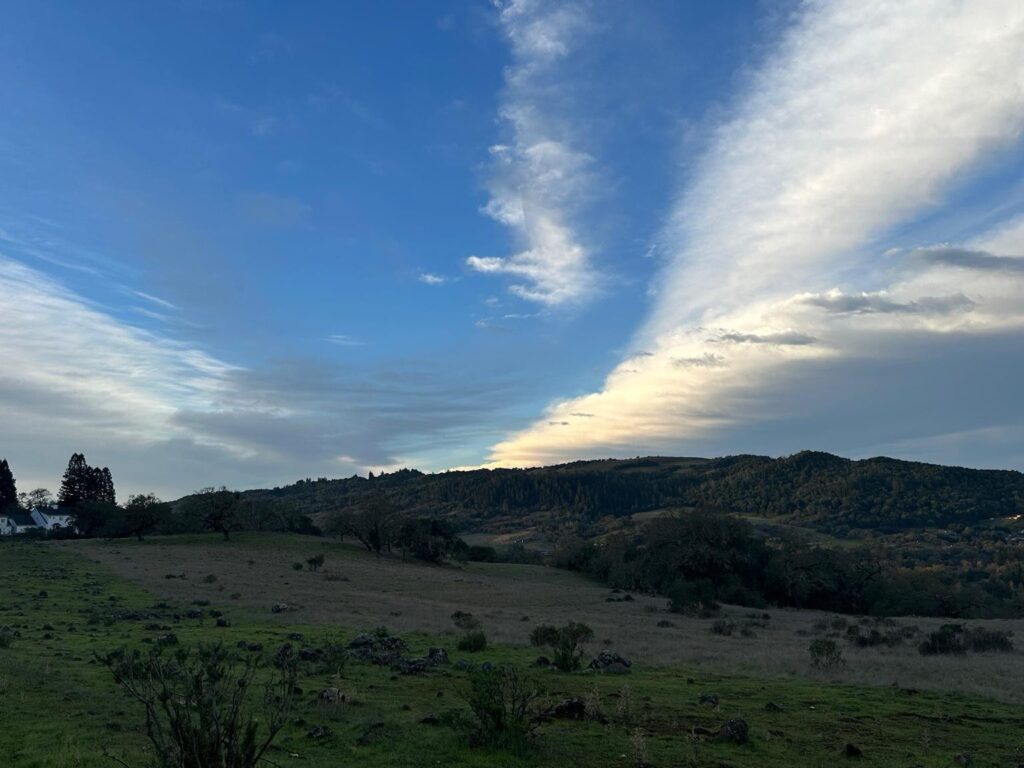
Mark and I talked early this morning about the dawning of a new day. He was walking as the conversation unfolded. While he walked, he sent two images and one later that carried more meaning than he may have realized. He said the crackling of recently fallen leaves under his feet added something to his morning. He was waiting for the sunrise to emerge, yet he was already sensing the nearness of God in what was around him. We discussed the sound the leaves were making as he walked because I could hear the sound through his phone. A quiet excitement grasped both of us. There was something spiritual about to be said. The leaves spoke to the work of God in creation. That simple moment brought Romans one verse twenty to mind. “For since the creation of the world God’s invisible qualities. His eternal power and divine nature. Have been clearly seen. Being understood from what has been made. So that people are without excuse.” That verse reminds us that God reveals Himself freely. Creation is not decoration. It is divine disclosure.
Everything God made carries traces of who He is. The sky that waits for the sun. The trees were outlined in the early light. Even the fallen leaves under Mark’s feet. All of it points to a God who communicates through what He creates. Mark’s photos captured three moments. The first was the horizon beginning to warm with red and gold, while the world still held the last notes of night. The second was a walkway full of leaves shaped by the season. The third was a vista that shone through the early morning dawning. All three images spoke the same truth. God is always revealing Himself. Sometimes He does it with color that draws our eyes upward. Sometimes with the soft crackling beneath our feet that invites us to listen. What Mark saw reminded me to look again. God communicates in ways that meet us where we are. Sometimes He speaks through Scripture. Sometimes through people. Sometimes, through the created world that surrounds every step we take. I am learning that the invitation is simple. Slow down. Pay attention. Notice the whisper in what appears ordinary. The God who formed the universe still speaks through what He has made. And He speaks to the ones who are willing to see.
Images from Mark

Jesus Didn’t Redefine Kinship, He Fulfilled It
Ron Randle
Mark and I have found that our mornings together have grown into something deeper than conversation. They have grown into kinship. We see in much the same way, not because we have tried to align ourselves, but because the same faith has been forming us. There is a shared confidence that emerges when the DNA is the same. Not personality. Not preference. Faith.
We share an awareness of how faith grows clearer with time rather than thinner. We are seeing with greater clarity what faith has historically meant, how it has been demonstrated through godly lives, and how God’s intent finds its fulfillment in Messiah Yeshua. That shared vision does not require persuasion. It produces recognition.
Like God’s work in Creation, His ways remain astounding as you witness them demonstrated in your own life. There is a particular joy that rises when faith resonates without explanation, when truth aligns without effort, and when unity forms not through agreement alone but through formation.
This is the confidence Mark and I are experiencing. A kinship shaped by the same faith that has been tested, clarified, and trusted over time. The root is shared. The fruit follows.
Kinship, in Scripture, has always been larger than bloodline. Abraham’s kinship was Chaldean long before Israel existed. Israel did not create Abraham. Israel came from him. Even then, the heart of Abraham’s kinship was never merely biological. It was rooted in faith. Those who trusted the promise belonged, not simply those who shared his ancestry.
When Jesus said, “Whoever does the will of my Father in heaven is my brother and sister and mother” (Matthew 12:50), He was not dismissing His own family. He was drawing from the deep well of Israel’s covenantal imagination. From the earliest narratives, the people of God were called to live as a people of belonging, shaped by shared story, mutual care, and responsibility for one another.
The ancient Jewish practice of the goel, the kinsman redeemer, embodied this ethic. It was not charity. It was covenantal. Boaz did not simply help Ruth. He stepped into her story, restoring dignity where loss had taken root and family where isolation threatened to define the future.
Jesus did not dismantle this framework. He fulfilled it. In Him, kinship was no longer constrained by bloodlines or tribal boundaries. It was reborn through obedience, forged through suffering, and sealed by the Spirit. The Church is meant to live as a genuine, authentic family. Note the wonder of Ephesians 2 in its entirety and be amazed.
Kinship, rightly understood, is not a concept to manage. It is a life to be lived. It is the quiet joy of
discovering that the same faith that shaped Abraham and found fulfillment in the Messiah is still forming people into a family today.
The Stones That Remember: Honoring God Through Quiet Remembrance
Ron Randle
Throughout Scripture, God repeatedly calls His people to remember. Not because memory comes naturally, but because forgetting does. We forget what God has done, how He has carried us, and how our lives are woven into a story larger than our own.
For that reason, God instructed His people to mark moments of encounter and deliverance with stones. These were not meant to impress or memorialize human achievement. They served as witnesses, holding memory in place so it could be handed down.
Stones endure in a way words often do not. Long after voices fall silent and generations pass, stones remain. In Joshua 4, after Israel crossed the Jordan River, God directed the people to gather twelve stones from the riverbed and place them on the far side. The reason was simple. When children later asked what those stones meant, the story of God’s faithfulness would be told again.
Those markers anchored truth to the land itself. They spoke of covenant, mercy, and God’s nearness with His people. They also pointed forward, anticipating a deeper act of remembrance Jesus would later establish when He said, “Do this in remembrance of Me.” Remembrance is important because forgetting slowly untethers faith. The stones were never about honoring the people. They existed to steady hearts toward trust in what God would do next.
Some believers live this call to remembrance in deeply personal ways. Mark Davidson is one of them. He lives quietly in Santa Rosa, California. Behind his home stretches an open field scattered with stones, one of which has become his place of prayer.
There is nothing remarkable about the stone itself. It is unmarked and unadorned. Yet over the years, it has carried prayers for family, work, friendships, and generations yet to come. Mark approaches that space with reverence, often asking God for permission to enter. Time spent there has shaped his trust and deepened his walk.
One day, Mark brought his eight-year-old granddaughter, Ada, to that stone and told her, “This is where I pray for you.” She listened. She did not fully understand, but she sensed that it mattered. That stone may become a part of her own story of faith. She may bring her children there and say, “This is where my grandfather prayed for me.” In that way, something ordinary becomes a living testimony, carrying the story of God’s faithfulness forward through one family.
This is how remembrance often works. Through repeated devotion. Through lives that honor God with time and attention rather than display. Mark’s field becomes more than land. It becomes a witness. The stone speaks without words. It quietly says that God met someone here and was trusted.
What does this teach us? That the mundane can carry lasting meaning and that those places where we meet with God deserve care. That remembrance strengthens obedience. And that every generation needs visible witnesses to unseen grace.
May we notice the markers God places in our own lives. May we honor the places where He has met us. And may those who come after us remember and trust the God who still meets His people.
Framing Note
This manuscript was created for Mark out of our weekday morning conversations throughout 2025—conversations marked by faith, curiosity, and a shared attentiveness to what God might be doing beneath the surface of ordinary life.
This final reflection that follows emerged from what Mark shared with me on the morning of December 16, 2025. His words, questions, and posture in that season did not simply inform the conversation. It shaped it. This final reflection stands as a response to that moment where Mark’s own seeking became the inspiration.
It is offered not as instruction, but as accompaniment. Not as conclusion, but as witness—to faith practiced in uncertainty, to trust formed in waiting, and to hope spoken not after clarity arrived, but while the change was still unfolding.
Nevertheless: Faith in an Unplanned Transition
Mark’s business is moving through a transition that was neither forecasted nor planned. Transitions always carry tension, but they become more demanding when they arrive without warning—when there are no clear data points, no immediate adjustments to make, and no obvious path forward.
In moments like this, waiting is not passive. It is weight-bearing.
This kind of waiting places a person in a spiritual liminal space—uncharted territory where familiar markers disappear, and faith is required not as theory, but as lived trust. That is where Mark finds himself. Not overwhelmed. Not frantic. But attentive.
Mark is not asking God to rescue him from uncertainty. He is seeking God within it. And his seeking is marked not by panic, but by curiosity—a posture of listening that assumes God is already present and already active, even if that activity has not yet revealed itself.
Mark loves reading the Old Testament—the Tanakh—because it reveals how God works. Not in ideal circumstances. Not after things are resolved. But in complex, conflicted, and often confusing realities. He sees in Israel’s story a God who does not wait for conditions to improve before speaking, intervening, or redirecting.
The questions Mark asks God about his business mirror those Israel asked in its own seasons of uncertainty. Where is God at work? What is He shaping beneath the surface? What does faithfulness look like when clarity is withheld?
In those moments, Mark allows the Spirit, in grace, to move him from the macro to the micro. He listens not for sweeping answers, but for small ones. Direction does not arrive as a master plan, but as a next step. A word. A nudge. A reframing.
Interestingly, Mark hears best in the quiet hours. When sleep breaks and the world grows still, he rises to read. Not to force answers, but to stay awake to God’s nearness. Those middle-of-the-night awakenings have become invitations rather than interruptions.
This morning, Mark told me about the sermon he heard this past Sunday on Isaiah chapter 9. To understand why it struck him so deeply, you have to remember the setting. Israel, at that point, was not honoring God in faithfulness or obedience. Leadership was compromised. Fear had replaced trust. Alliances had become substitutes for dependence on God. Darkness was not metaphorical.
Darkness was a lived reality as a consequence of their national sin. And yet, into that exact moment, God spoke hope.
Not after repentance was complete. Not once did circumstances improve. But right in the middle of the confusion.
Isaiah 9 begins with a word Mark has been living inside without naming it yet. “Nevertheless.” That word does not explain what God is up to. It reveals that God is up to something. The chapter goes
on to describe the promise of the Messiah. For Mark, this word added the spiritual vista of his life. It held both truths at once: hope deferred, and a promise that would be fulfilled.
“Nevertheless” names the space where faithful curiosity lives. The place where outcomes are unknown, but trust is intact. Where waiting is not wasted time, but formative ground. Where God’s work is real, even when it is not yet visible. This is not the absence of faith. It is faith maturing. And it is often here—quietly, without spectacle—that God does some of His most enduring work.
As we talked, I found myself telling Mark that watching God work in his life has been teaching me something of my own life. It has returned me to a question I keep learning how to ask—not with urgency, not with anxiety, but with trust:
What is God up to?
That question does not press God for explanations. It opens space. And nevertheless—this is the quiet confidence beneath Mark’s waiting—he knows that God is not stalled by uncertainty. God is not standing at the edge of this transition ,wondering what comes next. God is already present in the now and already active in the future, bringing about purposes that have not yet surfaced.
This is the promise Isaiah gives us. Hope does not wait for clarity. Light does not wait for conditions to improve. God does not wait for circumstances to cooperate. God speaks into the change. He works within the uncertainty. He moves through the waiting.
So Mark remains attentive where he is—not because he has answers, but because he trusts the One who does. His curiosity is not aimless. It is anchored. And in that posture, the unplanned transition becomes more than disruption. It becomes formation.
Watching this has pressed gently on my own life as well. There are places where I, too, would like more definition. More certainty and fewer unanswered questions. And yet I am learning again that faith is not lived from the vantage point of outcomes, but from the ground of trust.
Nevertheless—God is already at work beyond what I can trace. Nevertheless—He is not waiting for me to catch up. Nevertheless—what feels unfinished to me is already held by Him.
So I keep asking, not because I doubt His nearness, but because I trust His movement. What is God up to? The question is no longer a restless question for me. It has become a settled one. The future has not been revealed. But it has been entrusted.
And nevertheless, that is enough.
From Ron’s Journal — December 19, 2025
(Added to Mark and Me Reflections)
The Quiet Rhythm We Are Learning
“There is a quiet rhythm in the sanctification that many believers have difficulty recognizing. It is the rhythm of waiting before rejoicing, longing before fulfillment, preparation before celebration.”—rlr
Mark and I did not come together from strength. We came together from need. Each of us carried something unresolved. Spiritual kinship was not a preference for either of us. It was necessary.
Over time, kinship has become a pilgrimage.
What has marked this season is not speed. It is a restraint. Waiting has exposed what could not be hurried. Longing clarified what truly mattered. Preparation tested what we were willing to release.
We live in a culture that prefers outcome over formation. We want rejoicing without waiting. Fulfillment without longing. Celebration without preparation. Sanctification does not move according to appetite. It unfolds according to truth.
Grace has not removed the process. It has entered it. Transformation has not been theoretical for us. Grace has inhabited it, moment by moment, and we have both seen it.
What I have observed over these past two years is not progress measured by milestones. It is “change” measured by orientation. Alignment has replaced urgency. Trust has deepened where certainty was once felt necessary. What mattered early has loosened its grip. What remains carries weight.
This rhythm is not sentimental. It is demanding. Waiting humbles. Longing reveals attachment.
Preparation strips away what cannot be carried forward. Sanctification depends on this sequence.
Kinship grows where two lives consent to the same shaping. Not agreement. Not sameness. Consent. The grace of God has been evident because neither of us has tried to control the work.
The rhythm continues. Waiting still comes first. Longing still does its quiet work. Preparation still precedes any real celebration. And in this order, grace continues to form what neither of us could have produced alone—kinship developed through transformation.
Don’t Count What You Can Measure; Measure Only What God Can Multiply
(Mark Davidson inspired reflection. Mark is the call I make every weekday morning at 6:30 am. He’s walking his prescribed No Cal trail in Santa Rosa, CA, and I’m in So Cal sitting comfortably with my cup of Java in hand at the kitchen island, rooting for him. It works for us!)
“Don’t count what you can measure; measure only what God can multiply.”
October, 2025
Through Mark’s study of the Old Testament, he’s clearly heard the call of God around the word “build.” He continues to seek God as he studies, gaining clarity every day. Listening to Mark reminded me how God works—not on our timetable, but His, with him providing the resourcing.
When the Israelites were preparing to occupy the Promised Land, God said,
“Little by little I will drive them out before you, until you have increased enough to take possession of the land.”—Exodus 23:30
There was preparatory work to be done before what was promised could be received. I suspect that is what God is doing again, especially as you hear Mark’s full narrative of how God is revealing what He wants to build and how He intends to do it through the business he and his wife own.
We are wired in a way that requires ongoing transformation in how we think so that we can discern the good and perfect will of God. That process is rarely fast, but it is always fruitful. God multiplies without haste. He is never in a hurry. And yet, God is always right on time.
Throughout Scripture, God has been multiplying what little His people could offer—taking what looked like scarcity and turning it into sufficiency. He did it with Abraham, promising descendants as countless as the stars when Abraham didn’t even have a single child. He did it with Gideon, who won a battle with 300 men when he thought he needed thousands. And He did it with the widow in 2 Kings 4, who poured oil into borrowed jars until every one was full.
None of them had enough. But God didn’t ask them to count what they could measure. He asked them to trust what He could multiply.
That’s what Mark and I were talking about—how even the best of our thinking keeps us small when God’s math is so different. Our best reasoning still wants control. But trust invites surrender. The moment I stop counting what I can control and start trusting what God can multiply, I find freedom again.
It’s not about how much I produce, but how open I am for Him to produce through me. Five loaves and two fish were never enough—until they were given.
God’s delight is multiplying those things that reflect His character demonstrated through us. They are qualitative—things like faithfulness, mercy, and grace—and they often defy our ideas of how
success should look. God measures fruitfulness by resemblance, not results. What He multiplies most is what looks most like Him.
—Postscript—
“Here is a boy with five small barley loaves and two small fish, but how far will they go among so many?” Jesus said, “Have the people sit down.” … They all ate and were satisfied, and the disciples gathered twelve baskets with the pieces of the five barley loaves left over by those who had eaten.” —John 6:9–13 (NIV)
Discover more from Reflections & Musings by RLR
Subscribe to get the latest posts sent to your email.